Exploring the Suffolk Virginia Night Sky – Astronomy, Astrophotography, Telescopes, EAA – Planets and Stars and Nebula and Galaxies – Looking, Learning, Sharing… Let's see what we can see…
Very cool, fairly clear… a few thin clouds here and there early in the night, over all a very nice night to look up. Before dark I cooled the camera to -10 C and shot some new bin1 3 minute darks. Once the Sun went down I dialed in the Polar Alignment. I decided to have gather some light from M81 and M82. Based my Lightbucket looks like I did the same this time last year, but through the AT66.
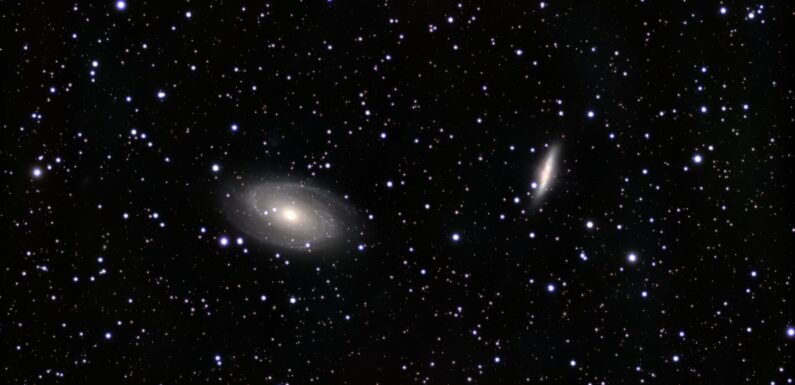
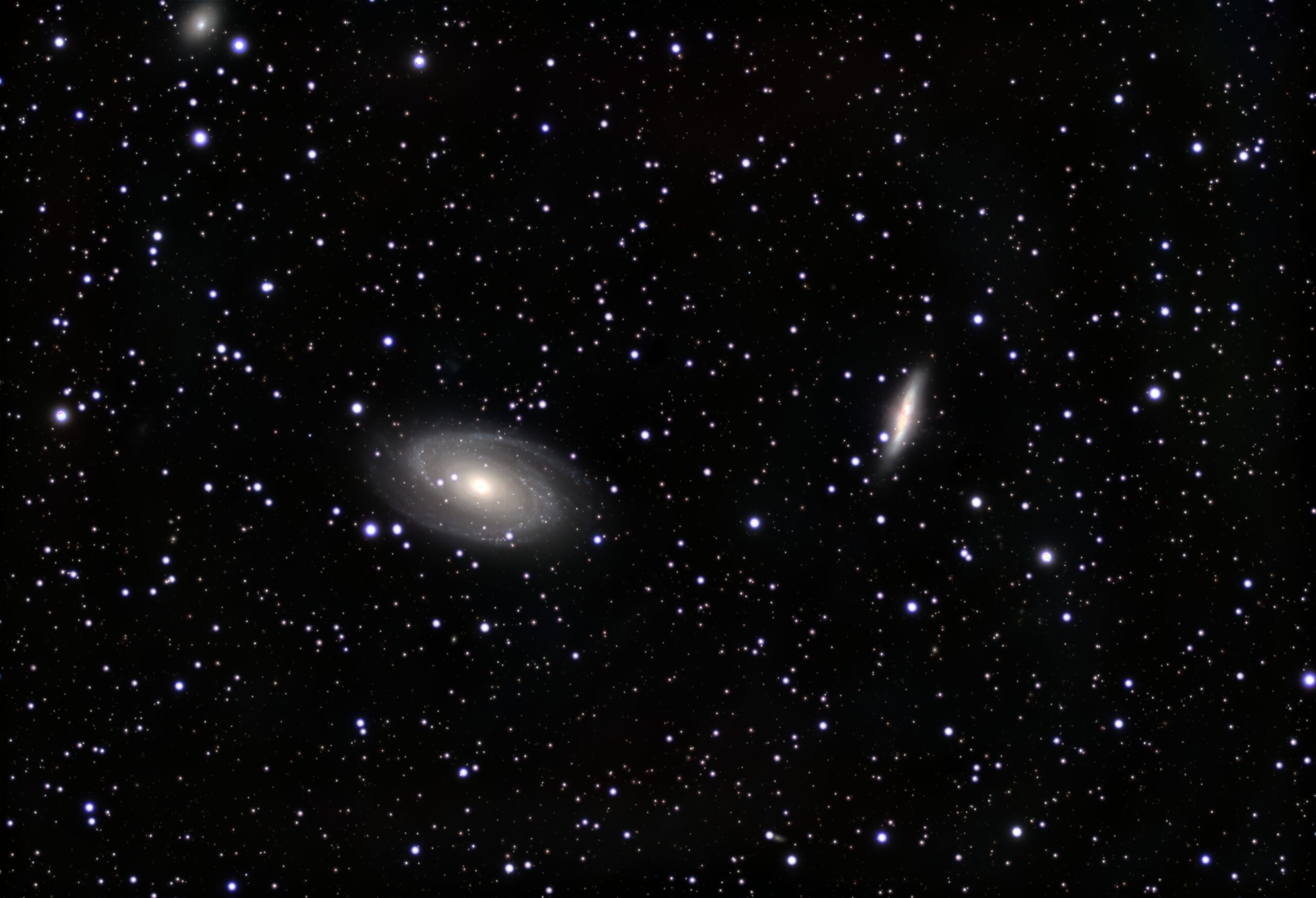
Messier 81 (M81), Bode’s Galaxy, a spiral galaxy about 12 million light years away and Messier 82, the Cigar Galaxy, a starburst galaxy also about 12 million light years away. These galaxies are located in the constellation Ursa Major. These galaxies are both members of the M81 Group.
My polar alignment was spot on. The NINA Sequence kicked off around 7 PM Eastern and the scope parked just after 2 AM. The camera collected 125 x 180 second exposures at gain 121, offset 30, bin 1. Just over 6 hours of data. My guiding RMS was ~0.4″ throughout the night.
Typically I use Sirilic to calibrate and stack. For this run I used the WBPP in PixInsight to calibrate with darks and stack. Really should have shot some flats… maybe next time.
Other than using WBPP to stack I also changed up my workflow slightly using the PixInsight processes SPCC and Gradient Correction to start and SetiAstro Cosmic Clarity to denoise. Then StarNet to create a star mask and a starless image and SetiAstro Statistical Stretch and Star Stretch to do the initial stretching, then Curves for a little fine tuning. Some pixelMath to put it all back together. Here are the results:
Some nice detail in M81, but if you zoom in a bit on M82 you can just see some of the details of the filaments extending out from the center.
Going to do a bit more tinkering in PixInsight to see if I can pull anymore details out of the data.