July 20th, 2010 by Hersey
Date: 7/18/2010
Time: 8:30 PM – 9:45 PM EDT
Scope: Stellarvue SV80BV FL: 750mm
Eye Pieces: 13mm Nagler, 9mm Nagler, 7mm Nagler, 4mm Radian
Mount: Stellarvue M1 Grab and Go Alt-azimuth
Location: Backyard, Suffolk, VA
Weather: Warm, low thin clouds, windy, cumulonimbus clouds and lightning to the northeast
Seeing: 4 Transparency: 4
Moon: 1st Quarter
The skies did not clear much over the weekend. Venus was very bright in the West on Sunday afternoon and could be spotted well before dark. I decided to set up the SV80 for a quick look. A thunder storm to the northeast was producing a lot of lightning so I decided to call it a night pretty early. Ended up viewing 3 planets, 2 of them well before dark.
From my observing notes:
Venus – Very bright and was easy to find even before the sun had set. Easy to see the phase at 9mm, 7mm, and 4mm. I think it is waxing since it appears there is more of the planet lit than in other recent observations. A purple halo was visible around the planet – not sure if this was because of the atmospheric conditions but if is not something I have noticed before. The halo was apparent in all eyepieces. The sharpest views of the planet were with the 9mm. The 7mm and 4mm views were not very sharp and showed a lot of wavy movement – similar image as looking down hot asphalt.
Moon – Very nice 1st quarter moon. Bright, white. Very sharp views with the 9mm and the 7mm. Some wavy turbulence could be seen at the edge with the 7mm but not bad at all with the 9mm. Very nice detail of craters and ridges at the line between dark and light. Sharpest most stable view with 9mm, the moon filled the FOV of this eyepiece very nice.
Saturn – Found Saturn well before dark in the 9mm eyepiece. Even before the sun went down I could make out the detail of the ring shadow on the planets surface. I was surprise to be able to see a single moon even before dark. Looked nice in the 7mm, but not as sharp. The 9mm was sharp and showed nice detail.
Mars – Not visible until dark. Orange disk in the 9mm. No other details visible. Tried to crank up the magnification with the 4mm but could not get a sharp image.
A satellite crossed nearly directly overhead (maybe a degree or 2 south of directly over head) at approximately 9:07 PM.
July 14th, 2010 by Hersey
I found this scale for transparency and seeing on Deep Sky Observing conditions page. I have not been recording the transparency, seeing, or limiting magnitude with my observation logs, but it is something that I should be doing.
The scales below for transparency and seeing are the ones I will be using for my logs. I am posting the scale here just to make it easy for me to reference, I am also going to include a print out of the scales in each of my log books.
————-
Seeing (atmospheric stability) and transparency (atmospheric clarity or clearness)
are rated subjectively on 1-10 scales that are based on the guidelines provided by the American Association of Amateur Astronomers.
Seeing is primarily influenced by atmospheric turbulence. The following scale
is used to rate conditions:
1 :: Chaotic: lowest power stellar images unsteady
2-3 :: Severely disturbed: low power planetary/nebulae images unsteady
4-5 :: Poor: medium powers unsteady
6-7 :: Good: only high powers unsteady
8-9 :: Excellent: only highest powers soft
10 :: Superb: all powers steady
Transparency is influenced by cloud cover, relative humidity, and light conditions
which illuminate airborne particulates, including light pollution, moonglow, and
residual sunlight. The following scale is used to rate conditions:
1 :: Mostly Cloudy
2-3 :: Hazy; 1 or 2 Little Dipper stars visible
4 :: 3-4 Little Dipper stars; Milky Way not visible
5 :: 4 Little Dipper stars; Bright parts of Milky Way visible (Scutum starcloud)
6 :: 5 Little Dipper stars; Milky Way visible with averted vision
7 :: 6 Little Dipper stars; Milky Way visible
8-9 :: Excellent: 7 Little Dipper stars; M-31 visible
10 :: Superb: M-33 and/or M-81 visible
Transparency and Seeing page for log book:
Log Book – Seeing and Transparency Scale :: LogBook-SeeingandTransparencyScale.doc
————-
Here is a nice transparency chart of Ursa Minor (the Little Dipper) from the Society for Popular Astronomy (SPA). Could be useful in helping to determine visual (naked eye) limiting magnitude.

July 12th, 2010 by Hersey
Date: 7/9/2010
Time: 9:15 PM – 11:00 PM EDT
Scope: Stellarvue SV80BV FL: 750mm
Eye Pieces: 22mm Panoptic, 9mm Nagler, 7mm Nagler
Mount: Stellarvue M1 Grab and Go Alt-azimuth
Location:Backyard, Suffolk, VA
Weather: Warm and cloudy.
Moon: None
It was pretty warm and mostly cloudy. A few breaks in the clouds as they passed allowed some views of Venus and Saturn. Around 10:00 PM it cleared up a bit to allow me to look for a few Messier objects. I was able to view M3 and M94. I looked for M51 but was unable to find it.
Not really the best night for star gazing, but I just felt like getting outside and looking up for a bit. I did not have an observing plan, I just used the July Sky Map to locate a few objects.
Since the conditions were not really good for deep sky observing I am happy that I was able to find a few things. By 11:00 PM the clouds had pretty much taken over the sky so I called it a night.
From my observing notes:
Venus was low in the west. Very bright. The phase appears to be a little over half, approaching gibbous. It was easy to see the phase in the 22mm, 9mm, and 7mm.
Saturn was very nice in the 7mm. Shadow of rings across planet surface showing good contrast. Only one moon was visible – Titan. I was able to see the ring shadow and moon in all eye pieces but the views were the best in the 7mm Nagler.
Messier 3 (M3) – From the bright star Arcturus I slowly worked to the west with the 22mm Panoptic until I was able find the fuzzy globular cluster. I could not resolve any individual stars at 22mm, 9mm, or 7mm. Just a faint fuzzy object with a brighter core. Going to have to revisit on a night that is darker and more clear.
Messier 94 (M94) – I was very surprised to be able to find this. I scanned between the two stars that make up the constellation Canes Venatici with the 22mm Panoptic. Very faint, small, with a faint border around a bright core.
I spent a bit of time looking for M51 but was unable to find it.
July 6th, 2010 by Hersey
Finally got the chance to try out the new to me Orion StarShoot Color Deep Sky Imager (DSI) II I picked up on Astromart Classifieds a while back. Saturday and Sunday night were both nice. Clear skies and cooler than it has been. A few clouds rolled by later on Sunday night, but still a great night.
For all images I used PHD for guiding, MaxIm DL Essentials for imaging with the DSI, and Deep Sky Stacker to stack the exposures.
On Saturday (7/3/2010) I set up to image through the Celestron 6″ SCT with a f/6.3 focal reducer while using the Astro-Tech 66ED to guide.
Early in the evening I used Venus to get the two scopes aligned and to test focus of the imaging camera and the guide camera.
After doing the two star alignment on the mount I used the polar align routine on the hand controller to make sure I had my alignment down. Not bad, had to make a few minor adjustments.
I then redid the two star alignment using Spica and Arcturus for my alignment stars and Antares, Deneb, Albireo, and Vega for my calibration stars.
The first target for the camera was the globular cluster Messier 4 (M4). It took some work to get the globular in focus, and I think I am still a little off – something I am going to have to work on a bit. The first set of images were over exposed, I changed the screen stretch to MaxVal and that fixed that. I ended up with 10 60 second exposures.

I then moved on the Messier (M80). I forced calibration in PHD after moving to each new object. I ended up with 10 decent 60 seconds exposures and stacked them to get the image below.

Messier 22 (M22) is a great globular cluster to observe visually and I think if I can increase my exposure times a bit it will be a great one to photograph as well. The image below is 12 60 seconds exposures stacked.

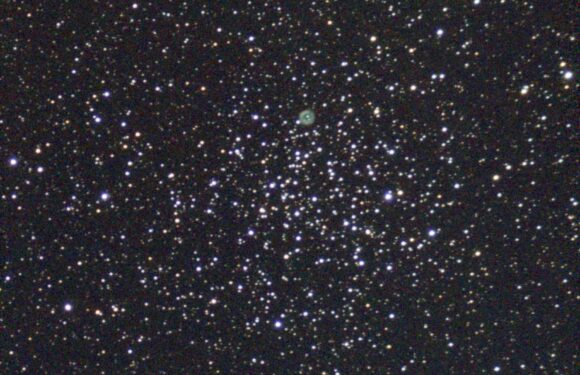
This one was not on my plan, but Mary Shannon had seen M57 at the SkyWatch on Friday night and wanted me to try to get a photo of it. Messier 57 (M57), also known as the Ring Nebula, turned out to be my favorite image of the night. My guiding was off, I think I have an issue with balance, but the 7 30 second exposures look pretty good stacked.

Sunday (7/4/2010) night was a bit warmer with a light breeze. I decided to image through the Astro-Tech 66ED with an Orion Skylight filter and use the Celestron 6″ SCT to guide. I just wanted to get a feel for the difference in imaging between the two scopes.
I went through the same alignment process as the night before. Again using Spica and Arcturus to align and Antares, Deneb, Albireo, and Vega for calibration. I did not do the polar alignment routine, the GOTOs to the calibration stars were pretty much dead on so I figured it was probably still in good alignment.
The first target was Messier 10 (M10). Here are 16 60 second exposures stacked.

Then on to one of my new favorites to observe Messier 20 (M20) the Trifid Nebula. It was hard to find in the camera at first, the nebula does not show up until you increase the exposures to 10 seconds or more, because of this it took some work to get it close to center. I ended up with 21 60 second exposures and I think it turned out great.

I still had a problem with guiding. It wanted to drift south and the guider could not keep up. Not sure if it is a polar alignment problem or a problem with balance. Going to have to look at this a bit more. The PHD test moves the mount fine E & W RA and N & S DEC so I think the guide pulses are being sent. Going to have to research this a bit more to figure it out.
Both the 6″ SCT and the AT66ED produced decent images with DSI. With the wider field it was easier to locate and center images in the AT66ED. I still need to work on fine tuning my focus but I am pretty happy with how the images turned out. I learned a lot about the camera, the scopes, and the process plus I really enjoyed taking them (that’s what really matters).
July 3rd, 2010 by Hersey
Date: 7/2/2010
Time: 8:30 PM – 11:45 PM EDT
Scope: Stellarvue SV80BV FL: 750mm
Eye Pieces: 22mm Panoptic, 9mm Nagler
Mount: Stellarvue M1 Grab and Go Alt-azimuth
Location: Northwest River Park, Chesapeake, VA
Weather: Cool and clear, a little humidity. A few passing clouds after 11:00 PM.
Moon: None
The Back Bay Amateur Astronomy club holds a monthly event called Skywatch at the Northwest River Park in southern Chesapeake. Sandy and I have been out there before to just look but this is the first time I have taken my own scope.
I have been trying to learn to better navigate the sky without using the GOTO computers on my CG5 mounts. I don’t have my mobile power worked out yet anyway so I figured this would be a good opportunity to do some star hopping using just a Skymap and a red dot finder. If I got totally lost or was not able to view anything there would be others there to help me get back on track or if I got totally frustrated with it there would be a number of other scopes to look through.
Sandy, Mary Shannon, and I loaded up the Xterra with the SV80BV, the M1 mount, a cooler with a few bottles of water, a couple of camp chairs, and the bug repellent. We arrived at the observing site in the equestrian area of NWR park at about 8:00 PM and set up. I have one cigarette lighter plug in the cargo area of the Xterra so I used that to power the dew heater controller.
I got everything set up and we waited for the sun to go down. Venus and Saturn were the first targets visible well before the sky was even dark. After that I started searching out globular clusters.
We had a really good time. I did not take a count but I would guess there were between 10 and 15 scopes set up – ranging in size from my 80mm refractor to Kent’s monster 25″ dob (the views of M13 through that thing are INCREDIBLE). I learned a lot about navigating the sky. Mary Shannon had a great time learning about the different constellations and stars. Both Mary Shannon and Sandy enjoyed looking through Ted’s 18″ Dobsonian that was set up next to us.
The Skywatch event is open to the public and if you get a chance you should check one out – the schedule is here. We are already looking forward to the next one.
From my observing notes:
Venus was very easy to spot well before dark. Though the scope you could easily see the phase of the planet using both the 22mm and the 9mm eye pieces. The phase is very similar to the gibbious moon phase (somewhere between the quarter phase and gibbious phase) I am not sure if it is waxing or waning. Because of the brightness it was actually hard to observe this as the sky became darker.
Saturn was beautiful as always. The shadow of the rings across the planets surface was very easy to resolve. It was approximately 9:10 PM when we were viewing it so the sky was not yet completely dark. I was only able to resolve the moon Titan.
Below are my two quick sketches I made in my log book of the phase of Venus and the location of Saturn’s moon Titan.

A BBAA member walked by (sorry I do not remember who) and said that Albireo would look good through my scope. He showed me where to look, and he was right. Albireo is a double star, it is the head of the constellation Cygnus. The double contains one larger blue star and a smaller gold/yellow star.
Messier 4 (M4) Very faint but it was easy to find by centering on Antares and slowly moving the scope to the west using the 22mm. The 9mm brought out more detail of the bright core and was able to resolve individual stars around the core.
Messier 80 (M80) Was also fairly easy to find by centering on Antares and slowly moving the scope up to about half way between Antares and Acrab (Beta Scorpii) in constellation Scorpius. It has a bright core, but I could not resolve individual stars to the core. Also tried with the 7mm Nagler.
Messier 57 (M57), the Ring Nebula, is found in the constellation Lyra about halfway between the stars Sheliak and Sulafat. M57 resolved as a fuzzy bluish thick walled bubble with the 9mm.
Messier 20 (M20), the Trifid Nebula, and Messier 21 (M21), an open cluster. This was one of my favorite targets of the night. Both M20 and M21 could be seen in the same FOV of the 9mm Nagler. I was able to resolve the dark lanes that separate the Trifid Nebula.
Mizar and Alcor is another double found in the handle of the Big Dipper. Mizar is a large blue star and Alcor is a much smaller blue star.
I did not note any specific details about these clusters. Basically a BBAA member (Ted) was calling these off and I was going looking for them. Messier 10 (M10), Messier 11 (M11), Messier 22 (M22), and Messier 15 (M15)
July 2nd, 2010 by Hersey
Date: 7/1/2010
Time: 9:15 PM – 11:00 PM EDT
Scope: Celestron C6-SGT and Astro-Tech AT66
Eye Pieces: 22mm Panoptic, 9mm Nagler, 7mm Nagler, 4mm Radian
Weather: Cool and clear
Moon: None
Alignment Stars: Arcturus and Spica
Calibration Stars: Antares, Deneb, and Altair
My observation plan was to observe a few globular clusters. I was looking for targets to possibly image over the weekend. The sky was very clear, I don’t think we have had skies this clear since early spring.
Since I had to get up early the next morning I did not get to spend as much time out as I would have liked. I spent most of the session observing M13 and M92. I also took a quick look at M4, M5, and M80.
From my observing notes:
Messier 13 (M13), the Great Globular Cluster in Hercules, was the first on my list/plan. Was able to see the cluster with the 22mm Panoptic in the C6 and I was able to resolve individual stars on the outer area of the cluster. The heart of the cluster was fuzzy without detail. At 9mm I could resolve individual stars closer to the center of the cluster and the 7mm Nagler showed even greater detail of what appears to be 100s if not thousands of stars.
With the 7mm Nagler in the AT66 the view was similar to the 9mm in the C6. A wider area but good contrast and I was able to see individual stars close to the center of the globular. I tried the 4mm Radian but had a hard time focusing. The scope was pointing nearly straight up which caused the Crayford focuser on the AT66 to slip from the weight of the eye piece – no issued with 7mm Nagler (which is considerably lighter). There is a tension adjustment on the focuser but it requires a small allen wrench and I did not want to fiddle with it in the dark.
Messier 92 (M92) – With the 7mm in the C6 I was able to resolve individual stars. This globular cluster seems much more compact. More stars in a smaller area. Did not take up as much of the FOV in the 7mm eye piece as M13.
I got a quick view of M4, M5, and M80 with the 9mm Nagler and the C6. I did not spend the same amount of time on these that I did on M13 and M92. The one note that I did make about M4 was that it appeared to not contain as many stars as M13 and M92.
I had great views of each of these globulars and I think M4, M5, and M80 will be on my list of targets for imaging this weekend.
Before ending the session I took a quick look at Saturn. The planet was much lower in the sky, near the horizon, so I did not have the same issue with the 4mm Radian slipping in the AT66. I could easily resolve the ring shadow where it crossed the planet. The 4mm in the C6 also allowed me to see some good detail.
June 29th, 2010 by Hersey
A quick thunder storm moved through southern Suffolk just a few minutes ago. It pretty much looks like it just grazed us with most of the storm to the south and east. The bright sun in the west mixed with the rain to the east produced a nice rainbow. Here are a couple quick pictures I snapped.


Check this out, if you look close you can see the sun light reflecting off the rain drops.

This rain is suppose to bring us some cooler temperatures and lower humidity for the next several days. Look likes this weekend is going to be a good one for observing and imaging.
June 21st, 2010 by Hersey
Date: 6/19/2010
Time: 9:30 PM – 11:30 PM EDT
Scope: Celestron C6-SGT and Astro-Tech AT66
Eye Pieces: 22mm Panoptic, 9mm Nagler, 25mm Plossl, 32mm Plossl
Weather: Warm, Humid, Few Passing Clouds, Breezy, Bright patio lights from neighbors
Moon: 1st Quarter
Alignment Stars: Spica and Arcturus
Calibration Stars: Vega and Antares
Did not really plan out my session. Even though I had a nap earlier in the day I was still kind of tired from being out in the morning, but I did not want to let the clear sky go to waste.
From my observing notes:
Messier 13 – The Great Cluster in Hercules – M13 is a globular cluster located in the constellation Hercules, I had to work a bit to get good focus using the 9mm in the C6. Once I was able to get focus it was very easy to resolve the individual stars outside of the clusters center. Also, able to resolve well with the 22mm. Focus was easier to obtain with the 22mm. While focusing on M13 with the 9mm Nagler I did notice a “mirror shift”, this is the first time I have experienced this in any of my scopes (not saying it has not happened before, this is just the first time I have noticed it).
I also observed M5, M10, M92, and M12. Messier 12 was the hardest of these to resolve.
Saturn looked very nice with the 9mm. The shadow of the planet’s rings were easily seen on the planet’s surface. The rings are still nearly edge on so there was no real detail to be seen. Three of Saturn’s moons were easily visible. I looked up the planet in Stellarium to figure out which moons we were seeing and they were Rhea, Tethys, and Titan. I am not very good a sketching but I did draw a small sketch of the moons locations so I could look it up.
The kids came out for a bit to look at Saturn , Mars, and the Moon. My son Johnathan stay out with me for most of the time I was out, which was cool since he is generally not into it.
We tried to look at M81 and M82 but both of these appeared as just smudges. M81 had a bright center but no detail and M82 showed no detail, just a smudge of faint light. I am not sure if it was because of the amount of light pollution or if these targets are just better suited for the 8″ scope. I have observed both of these with good detail in the 8″.
Around 11:30 we were over the heat, humidity, and mosquitoes so we called it a night.
June 20th, 2010 by Hersey
Date: 6/19/2010
Time: 2:00 AM – Sunrise (approx. 5:30 AM) EDT
Scope: Celestron C6-SGT and Astro-Tech AT66
Eye Pieces: 22mm Panoptic, 9mm Nagler, 25mm Plossl, 32mm Plossl
Weather: 66 deg F, Humid, Few clouds early in the session then clear.
Moon: None
Alignment Stars: Arcturus and Vega
Calibration Star: Enif
From my observing notes:
I started out observing Messier 11. This open cluster looked great in the C6 with the 22mm Panoptic. Very easy to see individual stars in the tight cluster. One bright yellow star just off center of the cluster.
Then I turned to Messier 39, another open cluster. This cluster filled the 25mm Plossl eye piece in the AT66 also looked good with the 22mm in the C6. Because of the size I actually liked the wider field of view the 66 gave better.
I viewed several other open cluster – M18, M22, M23, M28, M26, and NGC6633. When observing Messier 28 (M28) I was not able to resolve individual stars even with the 9mm, it just appear to be a faint cloud. I think the humid air and the fair amount of light pollution to the south was probably the reason for the less than spectacular views in the 9mm. NGC6633 was another cluster that really looked great in the AT66 with the 25mm Plossl, the cluster just filled the field of view.
Jupiter was easy to spot. The dark northern gas band was very easy to resolve with the 22mm and 9mm in the C6 (the southern band is missing) and the 4 Galilean moons were clearly visible in all eye pieces and all scopes. The 22mm Panoptic gave me the best views, the seeing was just not good enough for the magnification of the 9mm. Easy to see the 4 moons in the AT66, but no detail on the planet. I observed Jupiter on into sunrise, it was still easily visible in the scope even as the sun began to peek over the horizon.
When the star Capella rose to the north east I started searching the north east for Comet 2009/R1 (McNaught) with binoculars. I was not able to successfully locate the comet with my binoculars.
Very heavy morning dew ended the viewing, I was pretty surprised that I did not have more problems with dew. There was a light dew on the scope but the corrector remained fairly clear with just the dew shield. I am looking forward to getting my dew heater so that my troubles with dew will become a thing of the past.
I think Jupiter would have been visible even in full sun light.
June 18th, 2010 by Hersey
I have had my Side-by-Side Celestron 6″ and Astro-Tech 66m set up a couple of times over the last week or so hoping that the skies would clear. Finally last night – cooler temperatures and fairly low humidity – except for a few passing clouds it was nearly perfect visual observing.
I spent sometime using the moon as a point of reference to get the C6, the AT66, and the finder scope on the C6 all pointing in the same direction. The C6 was very much out of collimation and I used the collimation instructions that were included with Bob’s Knobs that I installed on the scope to correct this. Collimation was tedious and it took a few tries to get a feel for which knob(s) needed to be adjusted to move the diffraction rings in the correct direction but after I got the hang of it I was able to get the scope collimated – first with the 25mm Plossl and then with 9mm Nagler. I had never tried/worried about collimation, it took a bit of patience and several tries before I got it right, this process should be much easier in the future. I can see a difference between collimated and uncollimated when bringing an object into focus, but once in focus I did not really notice a difference between the two, this is really much more critical for astrophotography than for visual observing. I can also see where this process would be extremely hard using the secondary screws instead of the Bob’s Knobs.
Since it was a school(work) night and I knew that I did not want to be was not going to be out very late I did not go through the usual precise polar and GOTO alignment process. I just did a quick solar system alignment and had the GOTO point the scopes at Saturn. Used the 25mm Plossl to get the ringed planet centered and then replaced the Plossl with 9mm Nagler – AMAZING!!! The 9mm Nagler gave me nice clear view at about 167x magnification with a 0.49 FOV with this little 6″ SCT. I could clearly see the shadow of the rings across the planet’s surface and I counted 4 visible moons. One moon was visible just over the planets rings. I was really amazed at the clarity and wide field of view. Compared to the view through my 8″ using a 15 mm Plossl (135x with a FOV of 0.37 degrees) the view through the 9mm Nagler was just incredible.
I was only out for about an hour before the bugs got bad (should not have been out there barefoot and wearing shorts) but that was OK since I have to be up early for work. If it had not been for the bugs I probably would have stayed out all night enjoying the views of Saturn (and others). Tonight it is Friday, no work tomorrow, and I am looking forward to getting Saturn (and hopefully Jupiter later in the night and then possibly another try at Comet McNaught) back in the scope. If the skies are clear I pretty sure I will be out most of the night.
I am glad I picked up this little C6 and I think I am really going to enjoy the side by side setup – especially after I get a chance to do some imaging.