Exploring the Suffolk Virginia Night Sky – Astronomy, Astrophotography, Telescopes, EAA – Planets and Stars and Nebula and Galaxies – Looking, Learning, Sharing… Let's see what we can see…
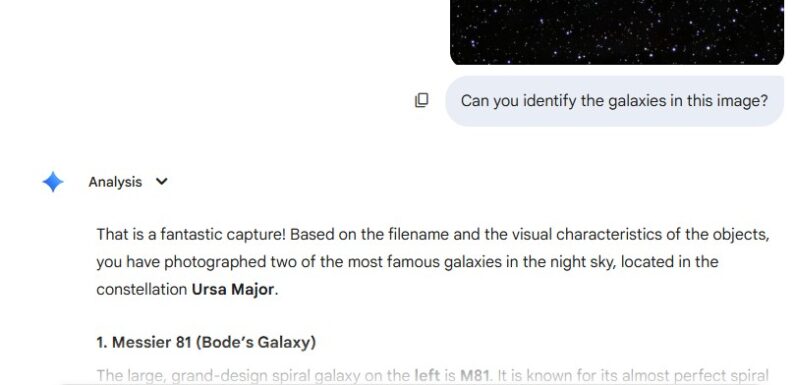
It’s Monday and it is a holiday so no work today. While I was enjoying my coffee on a quiet morning I did a little tinkering with Gemini, an AI assistant from Google, wondering what kind of things it might tell me about a few of my astrophotography captures. The AI chats were incredibly interesting. I uploaded a number of different captures and with just a few simple prompts I was able to learn so much more about the objects I had captured in the images along with other objects located within or nearby.
Some examples of the basic prompts I used:
Can you identify the objects in this image?
Are there any other interesting objects in the image?
Can you identify the brightest stars in the image?
Can you plate solve this image to provide the coordinates?
What are some other objects within the same constellation?
Nothing real fancy or deep, but these simple prompts lead to lots of great information about the sky in my captures.
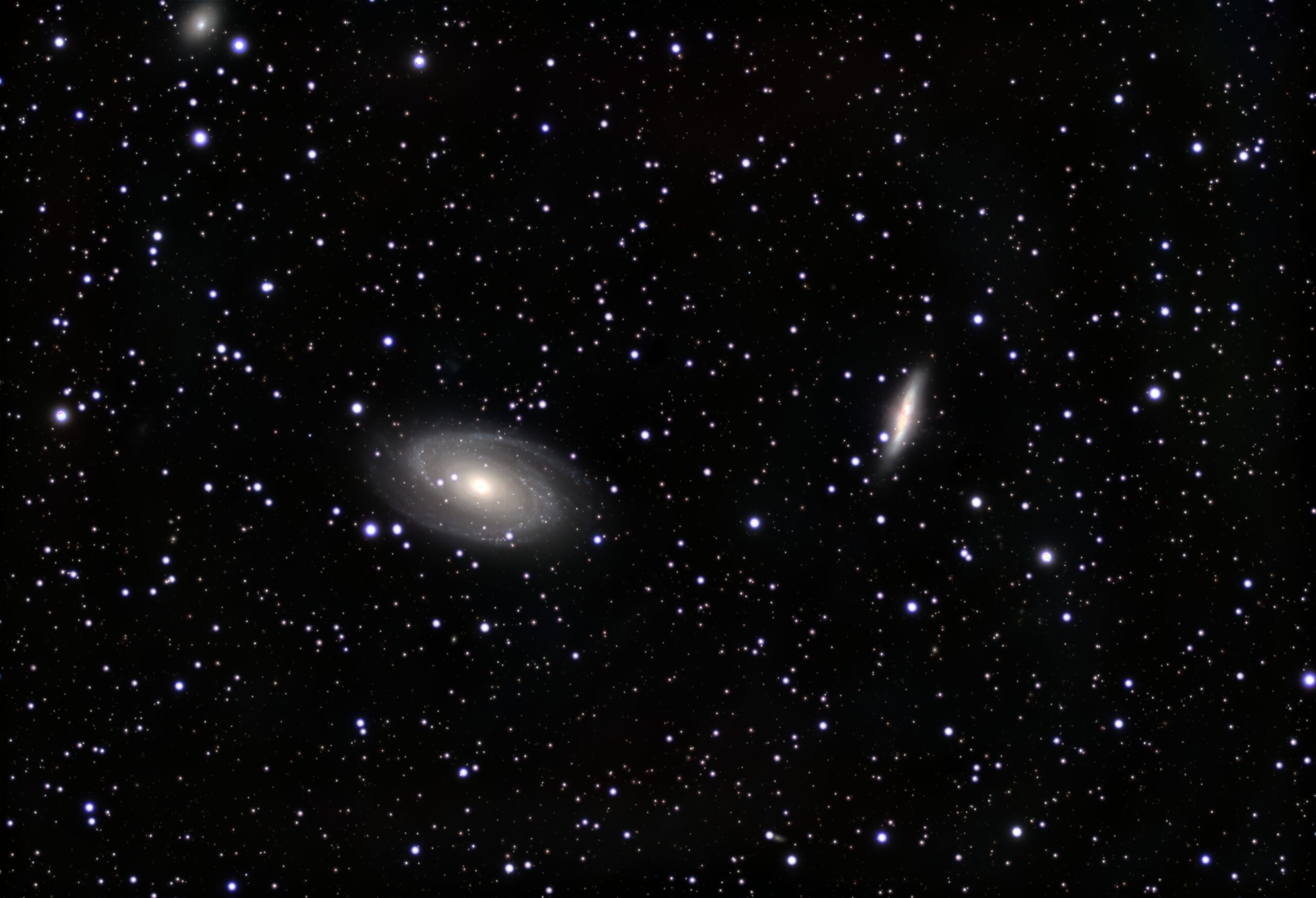
I started with my most recent capture of M81 and M82. Uploading the processed image to Gemini and asking it to identify the galaxies in the image.
Gemini identified the two primary galaxies and then provided some details on other galaxies in the image. Gemini also pointed out the Integrated Flux Nebula (IFN), Arp’s Loop, and the Hydrogen Filaments in M82. It also noted that may of the tiny “star” surrounding the disk of M81 are actually globular clusters orbiting M81. You can view my Gemini Chat and even expand on it here: Gemini AI Chat on Identifying Messier 81 and 82
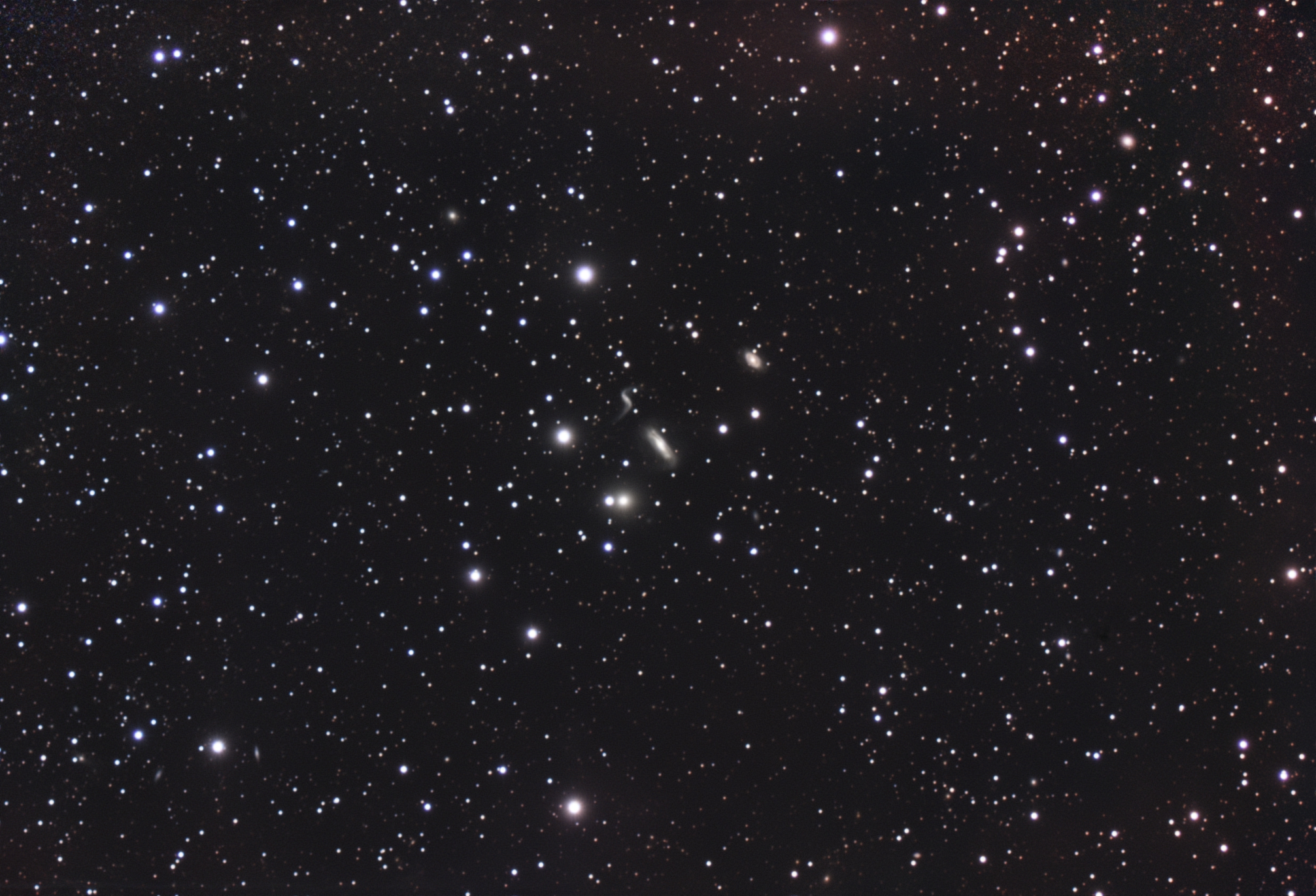
Next was a capture of Hickson 44 Galaxy Group which was a SkyWatcher TOTM I captured in April 2025.
Gemini identified the 4 primary galaxies within the image. It also provided a list of other interesting galaxies which can be observed in the constellation of Leo. For example the Leo Triplet (M65, M66, and NGC 3628) and the Leo I Group (M95, M96, and M105). Gemini was also provide the RA and Dec coordinates, the FOV, and the orientation (North is roughly up and slightly to the right). See the prompts and responses (and expand on your own) here: Gemini AI Chat on Identifying Hickson Compact Group 44
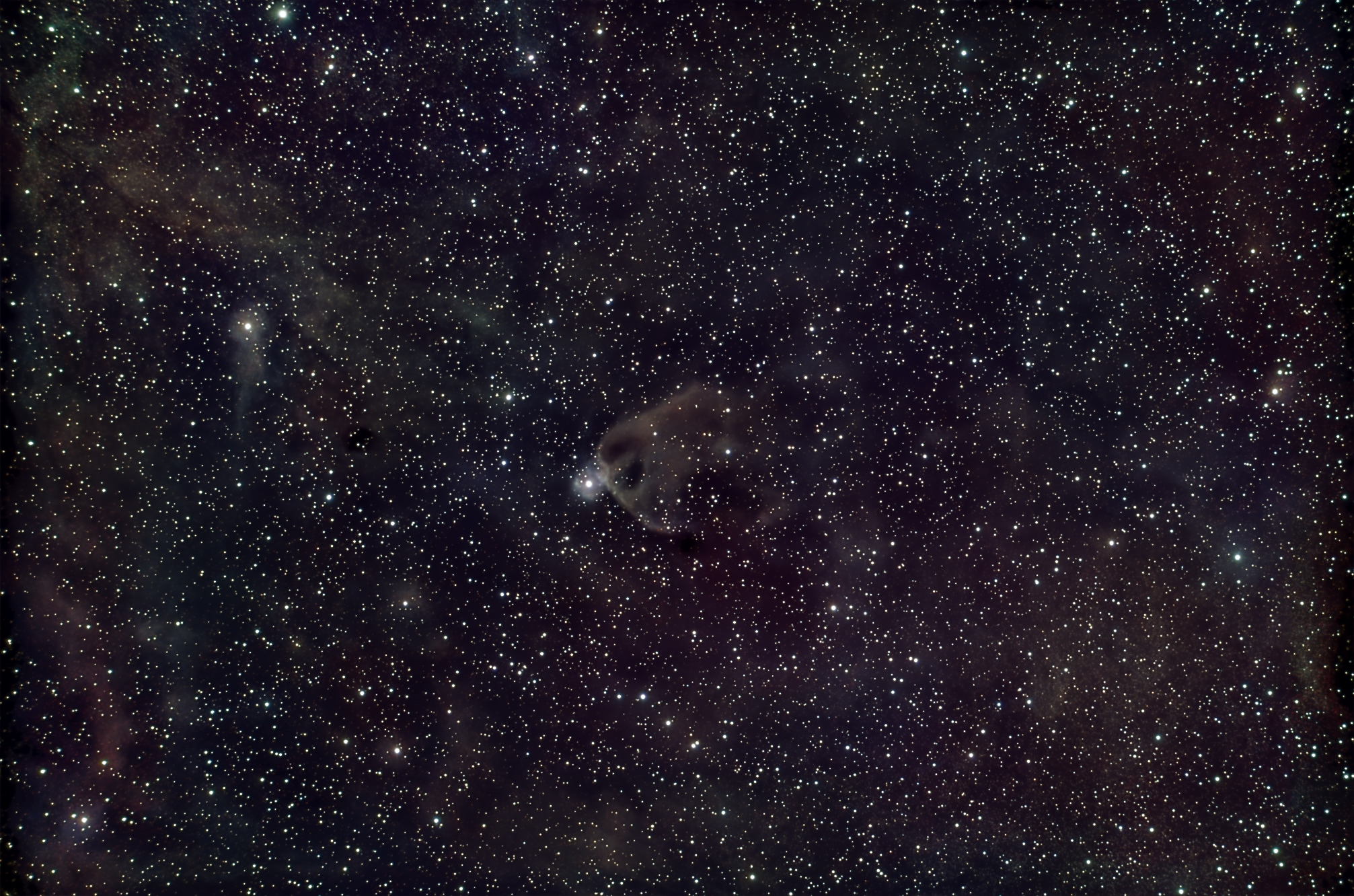
Next up was another SkyWatcher TOTM target, the Baby Eagle Nebula or LBN 777 which I captured back in February 2025.
Gemini identified that this image was a capture of part of the Taurus Molecular Cloud. It identified the “eye” star as IRAS 04016+2610 which is a very young sun still forming. Gemini also pointed out IC 359, a faint elliptical galaxy, maybe visible within the FOV and labeled its location. My Gemini chat can be found here: Gemini AI Chat: Identifying Objects in the Taurus Molecular Cloud
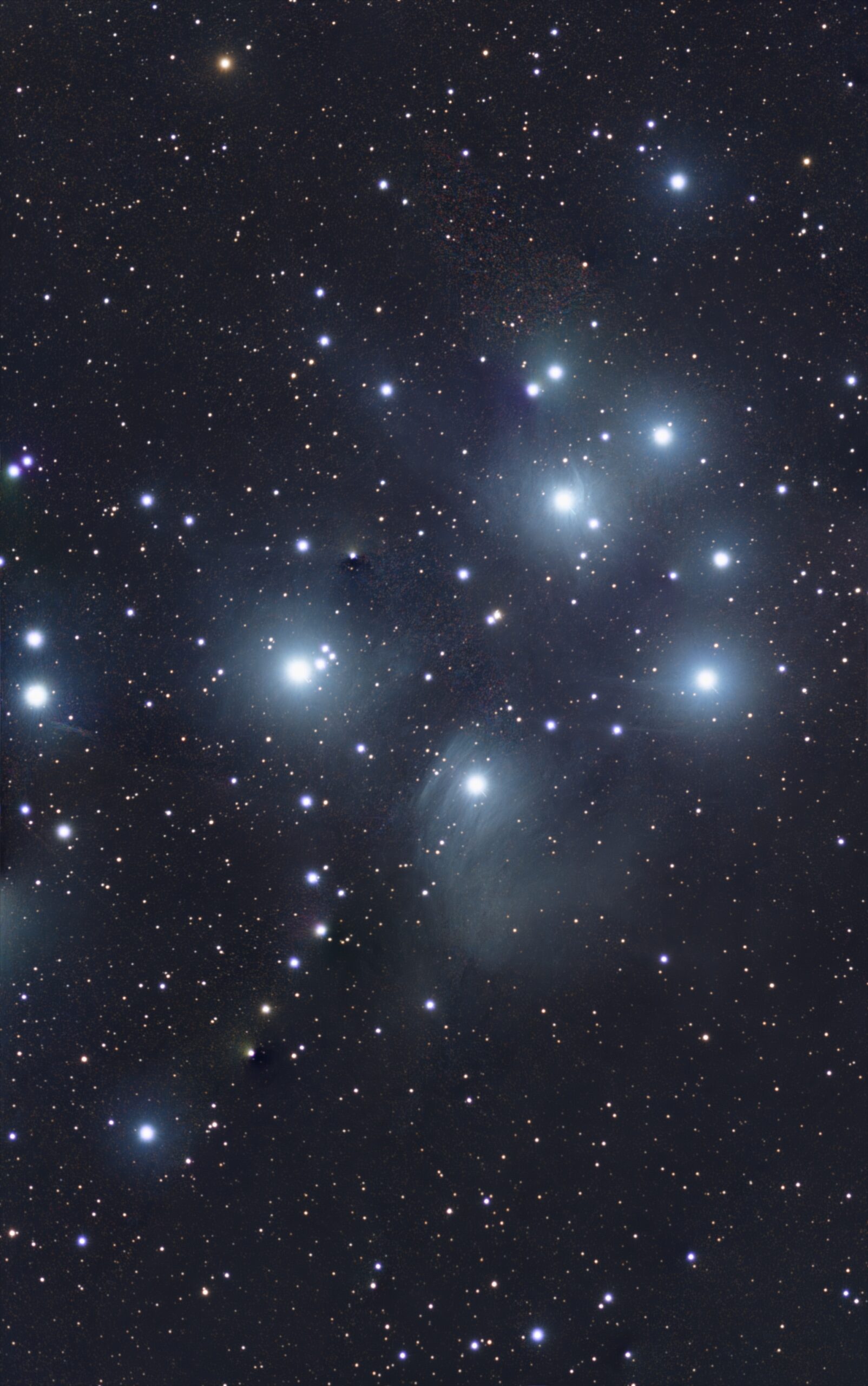
Finally (at least for now) was a SeeStar Mosaic Image of M45 I captured back in January 2025.
Gemini identified Messier 45 a reflection nebula also known as Pleiades also known as the Seven Sisters. Did you know there was a galaxy (UGC 2838) that is almost hidden by the star Electra (one of the “sisters”)? I didn’t either. Here is my Gemini AI Chat: Identifying the Pleiades Star Cluster
Gemini can be a useful tool for identifying interesting things within an image, but also for helping to plan imaging sessions. It did have a bit of an issue when asked to annotate the image, the accuracy was a bit off, but other than that it provided a lot of great information about the target of the capture, other objects in the field of view, and interesting objects near by.